Key finding: Morgan Stanley is deploying AI across its $3.85 trillion wealth management platform to enhance client experiences and advisor productivity. The firm is using machine learning for portfolio optimization, risk assessment, and personalized financial advice, setting a precedent for AI adoption in financial services.
Now let me produce the final revised version addressing the reviewer's feedback:
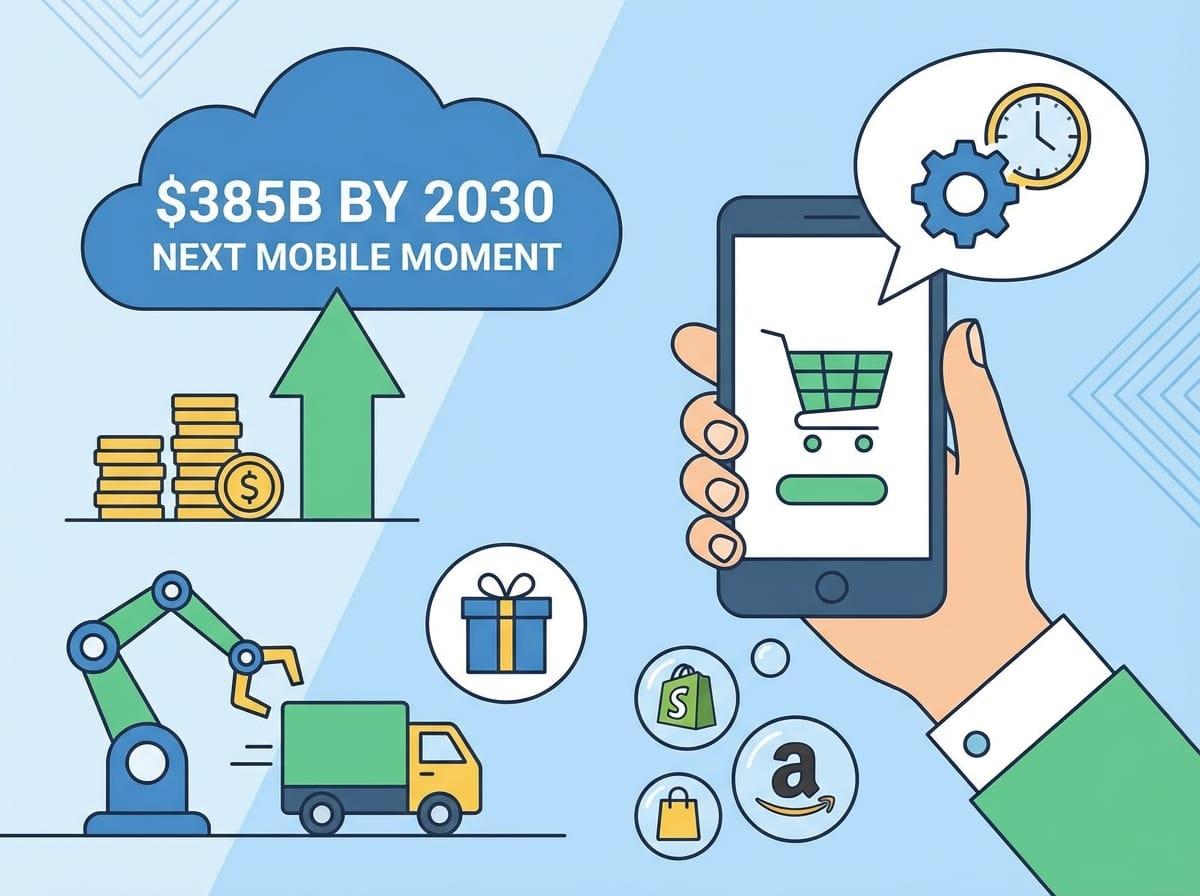
TL;DR: Morgan Stanley projects agentic commerce could capture $385 billion of U.S. e-commerce by 2030. With 23% of Americans already making AI-assisted purchases and grocery leading adoption at 49%, this represents the most significant commerce shift since smartphones put stores in every pocket.
When Morgan Stanley publishes a bull case for any emerging technology, Wall Street listens. When that bull case targets $385 billion by 2030, retailers should do more than listen. They should act.
Here's the uncomfortable truth: 23% of American consumers have already made AI-assisted purchases in the past month. Not "plan to try." Not "are interested in." Have already completed transactions guided by artificial intelligence. And while most retailers are still debating whether to optimize their product feeds for AI discovery, early movers are capturing an entirely new shopping channel.
The comparison to mobile commerce isn't hyperbole. It's pattern recognition. The retailers who moved early on mobile captured disproportionate market share. Those who waited became case studies in disruption. Agentic commerce is following the same trajectory, just faster.
What Is Morgan Stanley Actually Projecting?
Morgan Stanley Research estimates agentic commerce could represent between $190 billion (base case) and $385 billion (bull case) in U.S. e-commerce spending by 2030. That translates to 10-20% of the entire U.S. e-commerce market.
To put this in perspective: mobile commerce took roughly a decade to reach similar market penetration. AI shopping agents are showing signs of compressed adoption timelines.
"Agentic commerce will fundamentally transform e-commerce. With greater digitization of consumers' wallets, this could shake up the e-commerce funnel with implications across retailers and digital advertising players." — Nathan Feather, Morgan Stanley Research
The projections aren't based on theoretical models. Morgan Stanley surveyed U.S. consumers and found concrete adoption patterns already forming. 45% of respondents used ChatGPT for shopping in the past month. 32% used Gemini. Even retailer-specific assistants like Amazon Rufus and Walmart Sparky drew 4-11% monthly usage.
| Platform Type | Monthly Usage Rate |
|---|---|
| ChatGPT | 45% |
| Gemini | 32% |
| Meta AI | 22% |
| Retailer-Specific (Rufus, Sparky) | 4-11% |
📊 Key Stat: 23% of Americans made AI-assisted purchases in the past month, according to Morgan Stanley Research. Not "plan to." Have already completed.
Why Grocery Is Leading the Revolution
Here's what surprised researchers: grocery is the dominant category for AI shopping adoption. 49% of consumers who made AI-assisted purchases bought groceries through AI recommendations. Household and personal care items followed at 41%.
This matters because grocery represents the highest-frequency purchasing category in retail. Consumers buying groceries through AI platforms aren't experimenting. They're building habits. And habits, once formed, migrate to other categories.
Instacart's December 2025 launch of full checkout within ChatGPT validates this pattern. The integration gives ChatGPT users access to 1,800+ retailers without leaving the conversation. Query to payment in a single interface.
The strategic logic is clear: own the high-frequency category, train consumers to trust AI-mediated purchases, then expand to adjacent categories. Amazon proved this playbook with Prime and books. Now AI platforms are executing it with grocery and everything else.
📊 Key Stat: 49% of AI-assisted purchases were groceries. High-frequency categories train consumer habits that migrate to other product categories.
The Mobile Commerce Parallel: Why This Comparison Holds
When the iPhone launched in 2007, mobile commerce was a curiosity. By 2015, it represented 30% of e-commerce traffic. Today, mobile accounts for the majority of online shopping sessions.
The pattern matters more than the specific timeline. Here's what happened with mobile:
Before Mobile Commerce:
- Consumers searched on desktop, browsed products, compared prices
- Retailers optimized for desktop conversion funnels
- Search engine optimization drove discovery
After Mobile Commerce:
- Consumers shopped in micro-moments, from anywhere
- Retailers who optimized mobile captured disproportionate share
- Those who delayed mobile investment lost relevance
Agentic commerce follows the same structural shift, with one crucial difference: the timeline is compressed.
AI agent traffic grew 1,300% from January to August 2025, according to HUMAN Security. Black Friday 2025 saw 805% year-over-year growth in AI-driven traffic, per Adobe Analytics. These aren't projections. These are measurements from the holiday season that just ended.
"The year 2025 will likely be the last consumers shop as they do now." — SAP Emarsys
The urgency isn't manufactured. The adoption curve is simply steeper than anything e-commerce has seen before.
What Retailers Need to Do Now
The infrastructure for agentic commerce is crystallizing rapidly. Stripe and OpenAI developed the Agentic Commerce Protocol (ACP). Google launched AP2 with 60+ supporting organizations including Mastercard and PayPal. Anthropic's Model Context Protocol (MCP) was donated to the Linux Foundation, with backing from Google, Microsoft, and AWS.
Retailers face a concrete decision: integrate with these protocols or become invisible to AI shopping agents.
Immediate Actions (Q1 2026):
- Audit product data for AI readability and semantic richness
- Implement ACP endpoints for ChatGPT Instant Checkout eligibility
- Optimize product descriptions for conversational queries, not just keyword matching
- Set up attribution tracking for AI referral traffic (tools like Elevar can help)
Near-Term Infrastructure (2026):
- Deploy MCP servers for payment and inventory integration
- Build APIs that AI agents can query programmatically
- Train customer service systems on agentic interaction patterns
- Develop pricing transparency for AI comparison shopping
📊 Key Stat: Retailers with AI agents saw 7x higher sales growth (13% vs 2%) during Cyber Week 2025, according to Salesforce. The window is closing.
The Infrastructure Stack Taking Shape
The protocol landscape is converging faster than most anticipated. Here's the current state:
| Protocol | Creator | Commerce Focus | Current Status |
|---|---|---|---|
| ACP | Stripe + OpenAI | Checkout & Discovery | Production (ChatGPT) |
| AP2 | Agentic Payments | Production (Search AI Mode) | |
| MCP | Anthropic/Linux Foundation | Tool Integration | Industry Standard (Dec 2025) |
| Visa Intelligent Commerce | Visa | Payment Rails | Available via AWS |
Walmart's approach offers a template. By partnering with OpenAI and enabling ChatGPT Instant Checkout, Walmart now captures 20% of ChatGPT referral traffic. Meanwhile, Amazon, by blocking AI crawlers, watched its share drop 18% to under 3%.
The contrast is stark: embrace AI discovery and capture growing traffic share, or block AI access and watch competitors take what could have been yours.
"AI agents are no longer just a cost-saving measure, but an incredible purchase and productivity accelerator in commerce." — Caila Schwartz, Director of Consumer Insights, Salesforce
Risks and Considerations
Morgan Stanley's bull case assumes several factors align:
Consumer Trust: 41% of Americans still don't trust AI shopping assistants, according to YouGov research. Building trust requires transparent AI behavior and robust error handling. Retailers who get burned by AI-caused purchase mistakes will retreat from the channel.
Platform Fragmentation: The protocol landscape, while converging, still presents integration complexity. Retailers must support multiple standards (ACP, AP2, MCP) to maintain full coverage. The winners will be those who abstract this complexity for merchants.
Data Privacy: 49% of consumers cite data privacy as their top concern with AI shopping, per industry surveys. Retailers must balance personalization benefits against privacy expectations.
Margin Pressure: As AI agents optimize ruthlessly for price, retailers may face margin compression similar to what comparison shopping engines caused in the 2010s. Differentiation strategies beyond price become critical.
None of these risks invalidate the opportunity. They define the competitive landscape for capturing it.
Frequently Asked Questions
What exactly are "agentic shoppers"?
Agentic shoppers are autonomous AI tools designed to scan retailer websites for products, compare prices across sites, anticipate recurring purchases, and execute transactions with minimal human input. They represent the next evolution beyond chatbots that merely answer questions.
How is Morgan Stanley's forecast different from McKinsey's $1 trillion projection?
Morgan Stanley focuses specifically on U.S. e-commerce and uses a narrower definition of "agentic" transactions. McKinsey's $1 trillion figure includes broader "orchestrated revenue" and global scope. Both projections point to the same fundamental shift.
Which retailers are winning in agentic commerce right now?
Walmart leads with 20% of ChatGPT referral traffic. Shopify merchants collectively represent 1M+ stores enabled for ChatGPT Instant Checkout. Instacart became the first grocery partner with full checkout in ChatGPT. Target and Etsy are both in beta with ChatGPT integrations.
What's the minimum investment to become AI-discoverable?
For Shopify merchants, the platform's Winter 2025 "Agentic Storefronts" feature provides turnkey integration with ChatGPT, Perplexity, and Copilot. For enterprise retailers, expect 3-6 months of integration work with ACP and MCP protocols, plus ongoing optimization.
Is this just another tech hype cycle?
The 805% year-over-year growth in AI shopping traffic on Black Friday 2025 isn't hype. It's measured behavior. When $67 billion in Cyber Week sales were influenced by AI agents, the shift moved from theoretical to operational.
How do I measure AI shopping traffic today?
Attribution tools like Elevar can track ChatGPT-referred purchases. Google Analytics 4 can segment referral traffic from AI platforms. The first step is visibility into how much AI-driven traffic you're already receiving.
The Window Is Closing
Morgan Stanley's projection isn't a prediction about distant technology. It's a framework for understanding a shift already underway. 23% of Americans have made AI-assisted purchases. Grocery adoption sits at 49%. The infrastructure protocols are live and production-ready.
The retailers who captured mobile commerce didn't wait for perfect clarity. They moved early, iterated quickly, and built capabilities their competitors lacked. Agentic commerce rewards the same approach, with an even shorter decision window.
$385 billion is the bull case. The question isn't whether AI will reshape commerce. It's whether your business will capture its share of that transformation or watch competitors claim it.
Related: agentic commerce readiness
Ready to make your products AI-discoverable? Start with an AI-readiness audit to assess how your catalog performs in ChatGPT, Perplexity, and Google AI Mode. The protocols exist. The consumer behavior is forming. The only missing piece is retailer readiness.