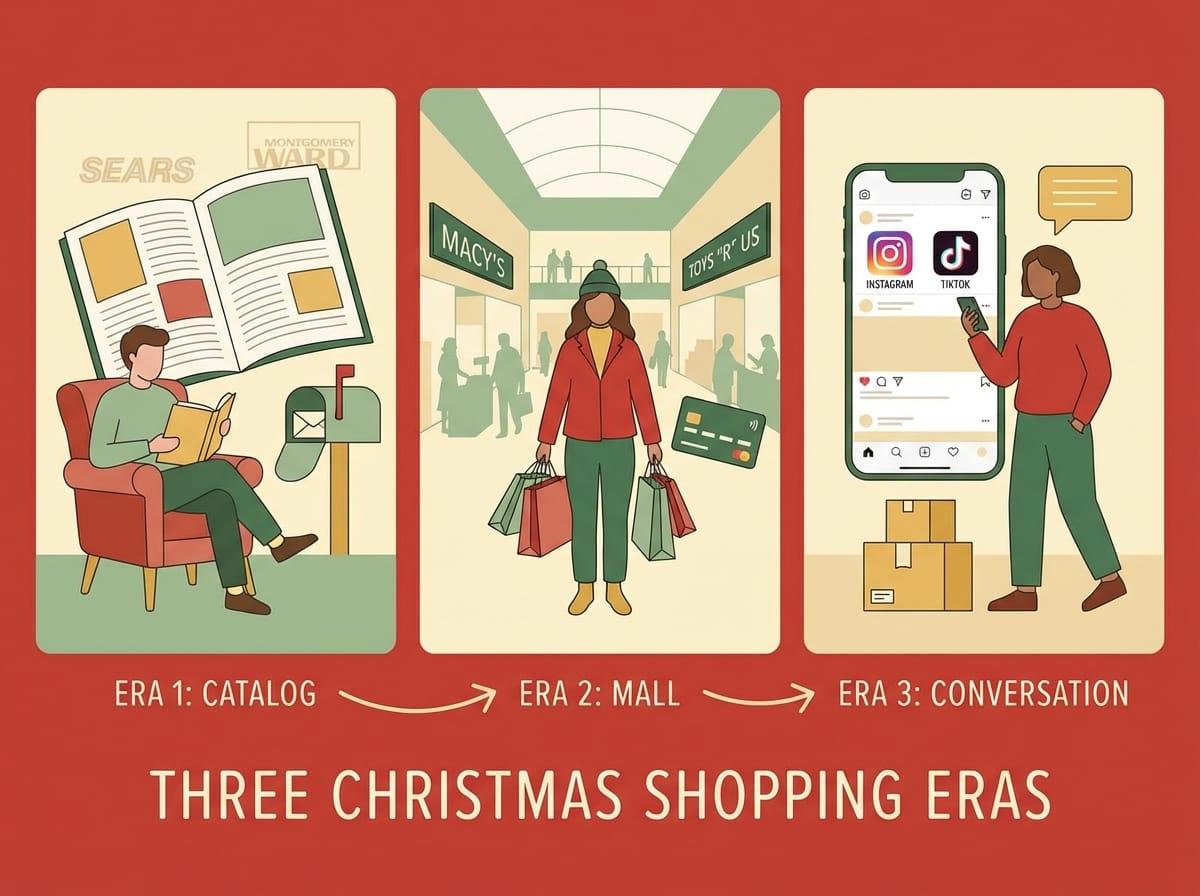
TL;DR: Christmas shopping has evolved through three delegation eras: the catalog era (2005) where we did everything ourselves, the AI assistant era (2025) where 42% of Gen Z uses ChatGPT for advice, and the autonomous agent era (2030) where AI handles purchases. The shift from "I'll find it" to "just handle it" transforms retail.
Picture December 2005. A dog-eared Sears catalog sits on the kitchen counter, pages folded at the corners. You're planning a trip to the mall tomorrow, armed with a handwritten list and the determination to find that perfect gift before the crowds get unbearable.
Now picture December 2025. You're asking ChatGPT: "What's a good gift for my sister who just started running and loves true crime podcasts?" Within seconds, you're reviewing personalized recommendations with links to purchase.
By December 2030? You might not picture anything at all. Your AI agent already handled the gift, selected based on years of preference data, ordered at the optimal price point, and scheduled for delivery.
This is a story of delegation. And it reveals something profound about how technology reshapes not just our shopping habits, but our relationship with choice itself.
What Did Christmas Shopping Look Like in 2005?
The catalog era demanded active participation. Finding the right gift meant physical effort, time investment, and personal expertise in knowing what people wanted.
The 2005 shopping experience:
- Browse 400-page catalogs marking possibilities
- Drive to multiple stores, navigate parking lots
- Compare prices by memory (no smartphone lookups)
- Stand in checkout lines for 30+ minutes
- Wrap and ship yourself
This was the "I'll find it myself" era. Success depended entirely on your own research, legwork, and gift-giving intuition. The process was exhausting but felt personal. You earned the satisfaction of finding that perfect present.
Key Stat: In 2005, e-commerce represented less than 3% of total retail sales, according to U.S. Census Bureau data. The mall wasn't just a shopping destination; it was a seasonal ritual.
The limitations were obvious. You only knew what you could see. Your gift options were constrained by what local stores stocked, what catalogs you happened to receive, and what you remembered from previous years. Great gift-givers were celebrated precisely because the skill was rare and hard-won.
How Is AI Changing Christmas Shopping in 2025?
The current moment represents a fundamental shift from search to conversation. Instead of hunting through stores or scrolling through endless product pages, shoppers now describe what they need in natural language and receive curated recommendations.
According to a Harris Poll/Mastercard survey, 42% of shoppers are already using AI tools for holiday shopping in 2025. Among Gen Z and millennials, more than half trust AI to recommend unique gifts.
This is the "help me find it" era. The shopper remains in control but delegates the research burden to AI.
The 2025 shopping experience:
- Describe the recipient and budget in natural language
- AI suggests options based on vast product databases
- Click through to purchase (increasingly without leaving the chat)
- AI tracks shipping and suggests wrapping services
"It fundamentally changes how people shop: moving from humans searching for products to AI bringing the right products, at the best price, directly to them." — Lori Schafer, CEO, Digital Wave Technology
Real example from 2025: A shopper asks ChatGPT, "What's a really good chopping knife for a beginner cook that's under $50 and I can buy on sale now?" The AI understands context, budget, skill level, and timing, then returns specific recommendations with purchase links.
How Fast Is AI Shopping Adoption Growing?
The numbers reveal an acceleration that caught many retailers off guard. AI-driven traffic to retail sites grew 805% year-over-year on Black Friday 2025, according to Adobe Analytics. This represents the fastest-growing category in e-commerce history.
| Metric | 2024 | 2025 | Change |
|---|---|---|---|
| AI-Driven Traffic (Black Friday) | Baseline | 805% Growth | +805% YoY |
| Shoppers Using AI | ~15% | 33% | +2x |
| ChatGPT Daily Shopping Queries | ~10M | 50M | +5x |
| Retailers with AI Agents | Minimal | 97% of large U.S. retailers | Near-universal |
The transformation isn't gradual. ChatGPT now processes 50 million shopping queries daily. Walmart captures 20% of referral traffic from ChatGPT. Shopify merchants saw 7x growth in AI traffic and 11x growth in AI-driven orders since January 2025.
Key Stat: During Cyber Week 2025, retailers with AI agents saw 7x higher sales growth (13% vs 2%) compared to those without. The competitive advantage is no longer theoretical.
The quality of AI-referred traffic matters as much as the volume. Visitors arriving from AI platforms spend 32% more time on site, view 10% more pages, and have 27% lower bounce rates, according to Adobe Analytics.
What Will Christmas Shopping Look Like in 2030?
The logical endpoint of the delegation trend is full autonomy. By 2030, McKinsey projects agentic commerce will orchestrate $1 trillion in U.S. retail transactions. Morgan Stanley's bull case suggests $385 billion in AI-driven purchases by that date.
This is the "just handle it" era. AI agents won't just recommend products; they'll purchase them on your behalf.
The 2030 shopping experience (projected):
- Your AI knows your gift recipients from years of data
- It monitors prices, availability, and new releases automatically
- It purchases at optimal timing without requiring your approval
- Gifts arrive wrapped, timed for the holiday, within your preset budget
"The transformation ahead isn't just technological; it's psychological. We're recalibrating our relationship with choice itself, learning when to delegate decisions and when to maintain control." — Luca Cian, Marketing Professor, UVA Darden
The seeds of this future are visible today. Amazon's "Buy for Me" feature already handles purchases across 500,000+ products. Alexa+ users complete 3x more on-device purchases than classic Alexa users. The infrastructure for autonomous purchasing exists; consumer trust is the remaining barrier.
"True autonomous shopping where AI agents truly understand you...isn't quite here yet for this holiday season." — Tyler Murray, Director of US eCommerce, Adobe
Why Does This Transformation Matter for Retailers?
The shift from search to conversation to automation represents an existential challenge for how retailers reach customers. The storefronts, SEO strategies, and advertising models built for human browsers may not work for AI agents.
Consider the divergent paths of two retail giants:
| Approach | Walmart | Amazon |
|---|---|---|
| AI Crawler Policy | Open access | Blocked |
| ChatGPT Referral Share | 20% (up 15%) | <3% (declined 18% MoM) |
| AI Shopping Integration | ChatGPT Instant Checkout | Closed ecosystem (Rufus only) |
| Strategy | Embrace external AI | Protect internal AI |
Walmart's partnership with OpenAI gives it visibility across AI shopping platforms. Amazon's decision to block AI crawlers removed 600 million product listings from AI results, according to Digiday. Both strategies carry risk. Only time will reveal which bet pays off.
Key Stat: By 2026, Gartner predicts a 25% drop in traditional search engine volume as users shift to AI chatbots. Retailers optimizing for yesterday's discovery methods are fighting the last war.
How Are Consumers Responding to AI Shopping?
The emotional dimension of this shift deserves attention. Shopping has never been purely transactional. It carries meaning: the joy of discovery, the satisfaction of finding the perfect gift, the ritual of holiday preparation.
Consumer attitudes remain split. According to Bain & Company research, roughly 50% of consumers remain cautious about fully autonomous AI purchases. The other 50% are open to or actively using AI shopping assistance.
What drives adoption:
- 75% of shoppers say cashback or bonuses would increase trust
- 70% of AI shoppers report better overall experience
- 69% feel happier shopping with AI assistance (Capgemini)
What creates hesitation:
- 49% cite data privacy concerns
- 44% worry about unwanted subscriptions
- 41% fear overspending
- 38% doubt AI will select the right product
The gift-giving context adds complexity. Delegating a routine purchase to AI feels different than delegating the selection of a meaningful present for someone you love. The psychological barrier to autonomous gift-buying may prove higher than for everyday shopping.
What Does This Mean for the Future of Choice?
The three Christmas shopping eras reveal a broader truth about technology and human agency. Each era trades effort for convenience, control for efficiency.
The delegation spectrum:
- 2005 (Full Control): You research, travel, select, purchase, wrap, deliver
- 2025 (Shared Control): AI researches and suggests; you approve and purchase
- 2030 (Delegated Control): AI researches, selects, purchases, delivers on your behalf
Each step removes friction. Each step also removes a moment of human judgment. Whether this represents progress or loss depends on what you value about the shopping experience itself.
SAP Emarsys put it starkly: "2025 will likely be the last year consumers shop as they do now." The catalog-to-conversation-to-automation trajectory suggests they're right.
Frequently Asked Questions
What percentage of shoppers used AI for holiday shopping in 2025?
According to a Harris Poll/Mastercard survey, 42% of shoppers used AI tools for holiday shopping in 2025. Among Gen Z and millennials specifically, more than 50% trust AI to recommend unique gifts. This represents roughly double the adoption rate from 2024.
How much has AI shopping traffic grown?
AI-driven traffic to retail sites grew 805% year-over-year on Black Friday 2025, according to Adobe Analytics. For the full holiday season (November 1 to December 1), AI traffic increased 760% compared to the previous year. Shopify reported 7x growth in AI traffic since January 2025.
When will AI agents start buying gifts autonomously?
Early autonomous purchasing features exist today. Amazon's "Buy for Me" covers 500,000+ products, and Alexa+ users complete 3x more purchases than classic Alexa users. McKinsey projects agentic commerce will orchestrate $1 trillion in U.S. retail by 2030, suggesting mainstream autonomous purchasing within 5 years.
What are consumers' biggest concerns about AI shopping?
The top concerns are data privacy (49%), unwanted subscriptions (44%), overspending (41%), and incorrect product selection (38%). However, 75% of shoppers say financial incentives like cashback would increase their trust in AI shopping.
Which retailers are winning in AI-driven shopping?
Walmart leads with 20% of ChatGPT referral traffic and an official OpenAI partnership. Etsy also captures over 20% of referral traffic. Target holds nearly 15%. Amazon's decision to block AI crawlers dropped its share to under 3%, though its internal Rufus assistant sees strong engagement with 250 million users.
How does AI shopping differ from traditional e-commerce?
Traditional e-commerce requires active search: typing keywords, filtering results, comparing options. AI shopping uses natural language conversation: describe what you need and receive curated recommendations. The shift is from "pull" (you search) to "push" (AI suggests). This changes how retailers must optimize their product data and discovery strategies.
The Story Continues
The dog-eared Sears catalog from 2005 represented something beyond convenience. It was a promise: everything you might want, organized and waiting, if only you'd flip through and find it.
Twenty years later, the promise has evolved. AI doesn't just organize options; it understands intent. It doesn't wait for you to find; it brings what you need before you ask.
By 2030, the promise may complete its transformation. Not "here's everything you might want" or "here's what we think you need," but simply: "handled."
Whether that future feels liberating or unsettling may depend on how much you valued the search itself.
Sources:
- New York Times: ChatGPT Holiday Shopping
- Adobe Analytics: Black Friday AI Traffic
- Digiday: Walmart and Amazon AI Traffic
- TechCrunch: Shopify AI Traffic Growth
- McKinsey: Agentic Commerce Opportunity
- Morgan Stanley: Agentic Commerce Forecast
- SAP Emarsys: Future of Shopping
- Bain & Company: Consumer AI Adoption
- U.S. Census Bureau: E-commerce Historical Data