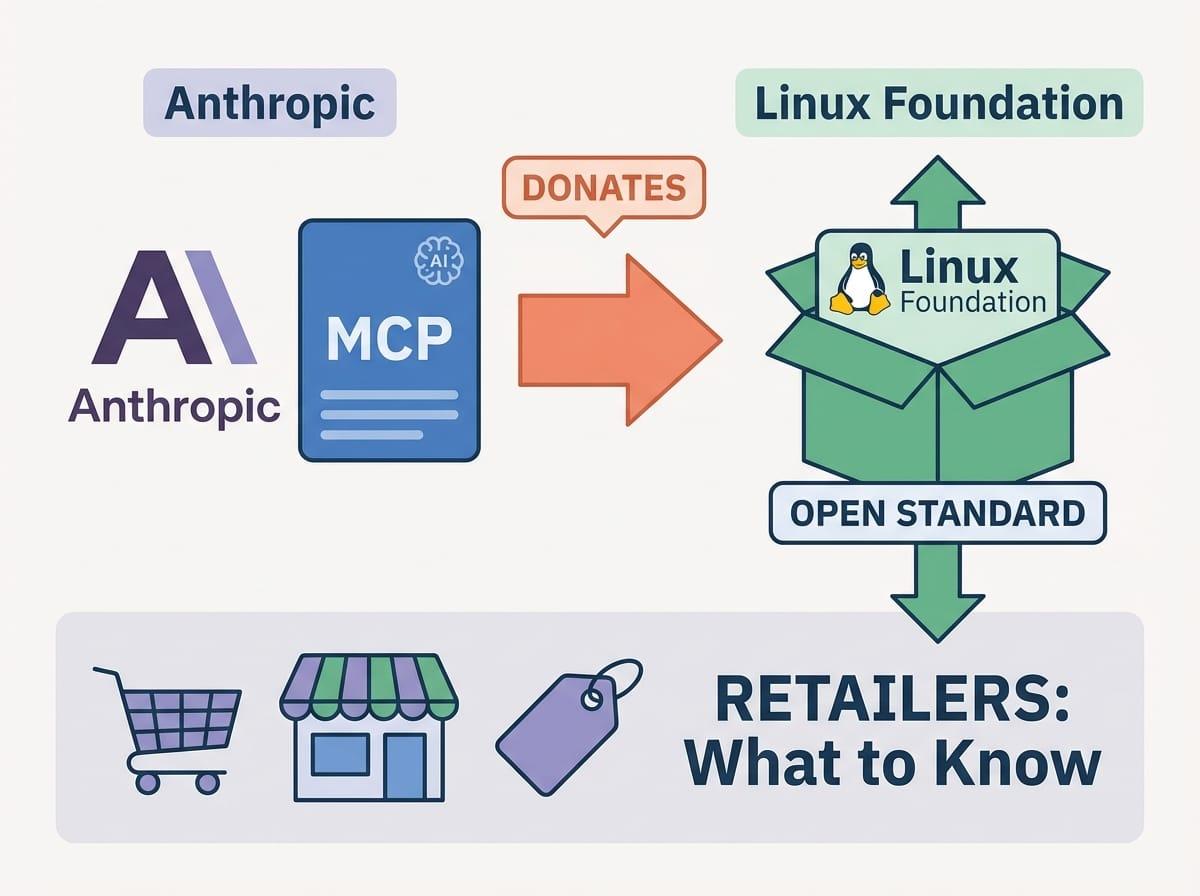
TL;DR: On December 9, 2025, Anthropic donated the Model Context Protocol (MCP) to the Linux Foundation's new Agentic AI Foundation—a watershed moment for retail. With 10,000+ MCP servers active, 97 million monthly SDK downloads, and platinum backing from Amazon, Google, Microsoft, and OpenAI, MCP just became the neutral infrastructure layer for AI commerce. Retailers integrating now gain first-mover advantage as AI agents increasingly control product discovery and purchasing.
What Just Happened and Why Retailers Should Care
On December 9, 2025, Anthropic donated the Model Context Protocol to the newly formed Agentic AI Foundation (AAIF) under the Linux Foundation. OpenAI contributed AGENTS.md (adopted by 60,000+ open source projects), and Block contributed goose. Amazon, Google, Microsoft, Bloomberg, and Cloudflare joined as platinum members alongside the founding companies.
This is not a minor standards body announcement. This is Kubernetes-level infrastructure becoming vendor-neutral—with direct implications for how AI agents discover, evaluate, and purchase products.
"AI agents are no longer just a cost-saving measure—they're an incredible purchase and productivity accelerator in commerce." — Caila Schwartz, Director of Consumer Insights, Salesforce
📊 KEY STAT: AI agent traffic grew 1,300% from January to August 2025, reaching 4.5 million requests per month.
What Is the Model Context Protocol?
MCP is the universal standard for connecting AI models to external tools, data, and applications. Think of it as USB-C for AI systems—a single protocol that lets any AI agent plug into any business system without custom integration work.
When Anthropic open-sourced MCP in November 2024, it was an internal tool solving their own teams' problems. One year later:
- 10,000+ public MCP servers active across the ecosystem
- 97 million monthly SDK downloads across Python and TypeScript
- Major platform integrations: ChatGPT, Cursor, Gemini, Microsoft Copilot, Visual Studio Code
According to Anthropic's announcement, the protocol has been adopted by enterprises deploying on AWS, Google Cloud, and Microsoft Azure. Mike Krieger, Anthropic's Chief Product Officer, stated: "A year later, it's become the industry standard for connecting AI systems to data and tools."
SOUNDBITE: "MCP under Linux Foundation is the Kubernetes moment for AI commerce. Vendor neutrality means everyone can build on it."
Why the Linux Foundation Matters for Commerce
The Agentic AI Foundation exists to prevent AI agent infrastructure from fragmenting into incompatible, locked-down products. Here is why that matters for retail:
| Before AAIF | After AAIF |
|---|---|
| MCP controlled by single company (Anthropic) | Neutral governance under Linux Foundation |
| Enterprise hesitancy about vendor lock-in | Trust signal for large-scale deployment |
| Protocol could pivot based on one company's interests | Community-driven, transparent evolution |
| Competitors reluctant to adopt | OpenAI, Google, Microsoft all participating |
The comparison to Kubernetes is intentional. When Google donated Kubernetes to the Cloud Native Computing Foundation (also under Linux Foundation), enterprise adoption accelerated dramatically. Container orchestration became infrastructure rather than competitive advantage.
According to TechCrunch's coverage, Linux Foundation Executive Director Jim Zemlin stated: "The goal is to avoid a future of 'closed wall' proprietary stacks, where tool connections, agent behavior, and orchestration are locked behind a handful of platforms."
MCP is following the same playbook—and retailers who recognize this pattern early will capture disproportionate value.
What This Means for Retail AI Integration
Platinum Members Signal Enterprise Readiness
The AAIF platinum roster reads like a who's who of commerce infrastructure:
- Amazon Web Services (cloud hosting for most e-commerce)
- Google (Search, Shopping Graph with 50B+ listings)
- Microsoft (Dynamics 365, Copilot)
- Anthropic (Claude AI)
- OpenAI (ChatGPT, with 50M daily shopping queries)
- Block (payment infrastructure)
- Bloomberg (data infrastructure)
- Cloudflare (global network infrastructure)
Gold members include Salesforce (Commerce Cloud, Agentforce), SAP (ERP backbone for enterprise retail), Shopify (1M+ merchants), Adyen (payments), Stripe (checkout infrastructure), and Snowflake (data infrastructure). Every layer of the commerce stack is represented.
📊 KEY STAT: Salesforce reported 119% year-over-year growth in AI assistant-driven online traffic in H1 2025.
Shopify Already Moved
Shopify rolled out built-in MCP support across all stores in their Summer '25 Edition. Every Shopify store now exposes an MCP endpoint (/api/mcp) by default. Through this endpoint, AI assistants can:
- Search product catalogs in real-time
- Retrieve product details, images, and pricing
- Add or remove items from carts
- Answer customer FAQs
- Initiate checkout processes
According to TechCrunch, Shopify saw 7x growth in AI traffic and 11x growth in AI-driven orders since January 2025. The MCP integration is not coincidental.
commercetools Commerce MCP
At Elevate 2025, commercetools introduced Commerce MCP to expose enterprise APIs—including carts, catalogs, pricing, promotions, inventory, and orders—in formats consumable by AI agents. This is infrastructure designed for a world where autonomous agents interact with APIs, not humans with screens.
SOUNDBITE: "Amazon blocked AI crawlers and watched 600 million listings vanish from the future of shopping. Walmart opened the door and captured 20% of ChatGPT referrals."
The Competitive Reality: Who Benefits, Who Falls Behind
Winners: Retailers Who Enable AI Access
According to Digiday, Walmart captures 20% of ChatGPT referral traffic—up 15% from July 2025. Their strategy combines proprietary AI (internal chatbot) with ecosystem access (ChatGPT Instant Checkout partnership). This dual approach exemplifies AI-first retail.
During Cyber Week 2025, retailers with AI agents saw 7x higher sales growth (13% vs 2%) compared to those without, according to Salesforce data. $67 billion in global sales were influenced by AI during that single week.
Losers: Retailers Blocking AI Crawlers
Amazon blocked AI crawlers, removing 600 million product listings from AI shopping results. Their ChatGPT referral traffic fell 18% month-over-month to under 3%, per Digiday. While Amazon still dominates traditional search, they are becoming invisible to the fastest-growing discovery channel.
The contrast is stark:
| Metric | Walmart (Enabled AI) | Amazon (Blocked AI) |
|---|---|---|
| ChatGPT Referral Traffic | 20% (up 15%) | <3% (down 18%) |
| AI Agent Visibility | Full catalog access | 600M listings blocked |
| Strategic Positioning | AI-first partnerships | Defensive posture |
📊 KEY STAT: During Black Friday 2025, AI-driven traffic grew 805% year-over-year, according to Adobe Analytics.
Protocol Landscape: Where MCP Fits
The AAIF announcement does not eliminate protocol competition—it clarifies the playing field:
MCP (Model Context Protocol): Now vendor-neutral under Linux Foundation. Universal standard for connecting AI to tools and data. 10,000+ servers, 97M downloads.
ACP (Agentic Commerce Protocol): Developed by Stripe and OpenAI (Apache 2.0 licensed). Powers ChatGPT Instant Checkout. PayPal, Worldpay, and commercetools support it.
AP2 (Agent Payments Protocol): Google and Mastercard initiative with 60+ organizations supporting (including PayPal, American Express, Shopify, Etsy).
A2A (Agent-to-Agent Protocol): Google-led with 150+ organizations in ecosystem. Enables multi-step commerce workflows.
Visa Trusted Agent Protocol: Partners include Microsoft, Shopify, Stripe, Worldpay. AI partners include Anthropic, Microsoft, OpenAI, Perplexity.
MCP becoming vendor-neutral makes it the likely winner for infrastructure-level integration. Commerce-specific protocols like ACP will likely run on top of MCP, not compete with it.
Key Insight: Microsoft's Dynamics 365 ERP MCP server entered public preview in November 2025—signaling enterprise-grade production readiness.
Action Plan: What Retailers Should Do This Week
Immediate (Next 7 Days)
- Audit your AI accessibility: Can ChatGPT, Perplexity, and Claude access your product catalog? If you are blocking AI crawlers, you are choosing invisibility.
- Review your Shopify/commercetools MCP status: If you are on these platforms, MCP may already be available. Enable it.
- Brief your CTO on AAIF: This is infrastructure that will shape the next decade of commerce. It deserves executive attention.
Near-Term (Next 30 Days)
- Evaluate MCP server implementation: For custom commerce platforms, explore MCP server deployment. The official SDKs support Python and TypeScript.
- Map your protocol strategy: Determine which combination of MCP, ACP, and A2A matches your commerce stack and customer base.
- Pilot AI agent checkout: If you are not already offering AI-assisted purchasing, you are falling behind competitors capturing AI traffic.
Strategic (Q1 2026)
- Build AI-first product data: Structure your catalog for AI consumption—not just human browsing. Agent-readable formats are becoming table stakes.
- Join the ecosystem: Consider AAIF membership (tiers from Platinum to Silver) to influence protocol direction and gain early access to roadmaps.
Frequently Asked Questions
What is the Agentic AI Foundation?
The Agentic AI Foundation (AAIF) is a new Linux Foundation project providing neutral governance for AI agent infrastructure. Co-founded by Anthropic, Block, and OpenAI, with platinum support from Amazon, Google, and Microsoft, it houses the Model Context Protocol (MCP), goose framework, and AGENTS.md standard.
Does MCP changing ownership affect my existing integrations?
No. According to Anthropic's announcement, "the governance model introduced earlier this year continues as is. The people making decisions about the protocol are still the maintainers who have been stewarding it." Existing MCP implementations continue working without modification.
How does MCP differ from the Agentic Commerce Protocol (ACP)?
MCP is infrastructure-level—it connects AI models to any external system (databases, APIs, business tools). ACP is commerce-specific—it handles checkout, payments, and transaction flows. They are complementary, not competitive. Most implementations will use MCP for connectivity and ACP for commerce operations.
What retailers are already using MCP?
Shopify enabled MCP across all 1M+ stores in Summer 2025. commercetools offers Commerce MCP for enterprise deployments. Walmart, Target, and Etsy are accessible to MCP-enabled AI agents through various integrations. Microsoft Dynamics 365 retailers can access MCP through the new ERP server in public preview.
Is MCP adoption required to remain competitive?
The data suggests yes. AI agent traffic grew 805% year-over-year on Black Friday 2025, according to Adobe Analytics. Retailers blocking AI access are seeing declining referral traffic share. SAP stated that "2025 will likely be the last year consumers shop as they do now." Visibility to AI agents is becoming as critical as SEO was a decade ago.
How much does MCP implementation cost?
For Shopify and commercetools users, MCP is included in existing platform fees. For custom implementations, the SDKs are open source and free. Enterprise deployment costs vary based on scale and security requirements, but early adopters report significant efficiency gains that offset implementation investment.
The Bottom Line
The Linux Foundation's Agentic AI Foundation is not just another standards body. It is the moment AI commerce infrastructure became truly neutral—with every major cloud provider, payment processor, and commerce platform at the table.
The window for competitive advantage is now. Retailers who integrate MCP-compatible infrastructure in Q1 2026 will capture AI agent traffic as it accelerates. Those who wait will watch competitors capture the customers they never see.
As SAP stated: 2025 is the last year consumers shop as they do now. The retailers who recognized this built for AI agents. The ones who did not are already becoming invisible.
Your move.
Sources:
- Linux Foundation: AAIF Announcement
- Anthropic: Donating MCP
- TechCrunch: OpenAI, Anthropic, and Block Join Linux Foundation
- MCP Blog: Joining AAIF
- commercetools: Commerce MCP
- Salesforce: Cyber Week AI Data
- Digiday: ChatGPT Referral Traffic
- TechCrunch: Shopify AI Traffic Growth
- Fox Business: Black Friday AI Traffic
- Microsoft: Dynamics 365 MCP Server